


Tennessee couple arrested after investigators find drugs, gun in raid on home day care
MEMPHIS, Tenn. — A couple is facing a list of charges after investigators found drugs, cash and a gun at their house, which was also operating as a home day care, according to court records.
Investigators said they caught Tony Butler, 36, selling drugs from his car Thursday outside the McDonalds on Getwell Road. Detectives had been watching him as part of a drug investigation.
Court records show detectives pulled up behind Butler and turned on their lights and sirens after he sold drugs to an undercover officer, but Butler tried to speed off and rammed a patrol car. Nobody was injured.
In Butler’s car, investigators said they found marijuana, cocaine, crack, fentanyl, heroin, ecstasy and promethazine cough syrup.
Detectives also raided a house on Valley Glynn Drive, where they say they found more cocaine, digital scales, cash stashed throughout the master bedroom and a .357 revolver in a living room closet.
All these items were found in the same home where investigators say Butler’s girlfriend, Shemeka Rodgers, 34, was running a home day care.
“It’s shocking and it’s scary,” one woman in the neighborhood, who didn’t want to be identified, said.
She said she constantly sees young children coming and going from the house.
“Just traffic in and out in the mornings and the afternoons, dropping children off and picking them up,” she said. “I would be terrified to think that my children had been there.”
WREG checked records from the Department of Human Resources, but out of the 10 licensed home daycare providers in that zip code, Rodgers isn’t listed.
WREG reached out to DHS to see if Rodgers has a license to operate a home day care in Tennessee, but haven’t gotten a response.
She and Butler will be in court Monday.
Photo Credit: pix11.com

Texas Police Officer Firing Gun at Dog Running at Him Shoots and Kills Woman
A rookie Texas police officer accidentally shot and killed a woman behind a shopping plaza when he fired repeatedly at a dog believed to be hers that was running at him, authorities said Friday.
The officer in the Dallas suburb of Arlington, who was released from supervised duty on July 1, responded to a welfare check Thursday about a woman who appeared to be passed out in a grassy area behind the plaza. Footage from the officer’s body-worn camera released Friday shows the officer walking along a sidewalk and calling out, “Hello. Are you OK?”
The woman replies, “Yeah, I’m fine.” A dog approaches and the officer asks, “Is that your dog?”
As the barking dog runs toward him, the officer yells, “Get back!” He begins to back up and then fires three shots. The woman screams, “Oh, my God!” and continues to cry out.
Police Chief Will Johnson said at a news conference that the dog, which he described as a Labrador mix, weighed about 40 pounds. Investigators think the dog belonged to the woman, who the Tarrant County medical examiner’s office identified as 30-year-old Margarita Victoria Brooks.
Brooks was shot in the “upper torso,” Johnson said. The dog suffered a flesh wound and has been quarantined, the chief said.
“Everything about this call is an absolute tragedy,” a somber Johnson said. “Our hearts are broken for the Brooks family and for the officer involved. Our officer was on scene trying to find an individual who may be suffering from a medical emergency. Clearly, this is not the outcome the officer wanted, nor is it the outcome that the department wanted.”
He said Brooks’ family has been shown the body camera video, and that criminal and administrative investigations are underway.
The 25-year-old officer, whose name hasn’t been released, graduated from the police academy in February and hadn’t fired his service weapon in the line of duty before Thursday, Johnson said. He has been placed on administrative leave.
People who live and work near where the shooting occurred said they often saw Brooks walking with her boyfriend and that the couple appeared to be homeless. They said the pair always had a dog with them.
Larry Hamilton told the Fort Worth Star-Telegram that he lives in a nearby apartment but was homeless for several years and knew Brooks. He said she was “a good-hearted person” who always made sure the dog was fed before she was.
Photo Credit: Getty Images

O.C. Mother, Daughter Cheated Agencies Out of $190K in County’s ‘Largest Housing Fraud Scheme
A mother and daughter face felony welfare charges after allegedly bilking county agencies out of nearly $200,000 in what prosecutors on Friday called the “largest housing fraud scheme in Orange County history.”
Errica Madkins Mickens 56, and Brittany Monet Mickens, 29, were arrested on Thursday, according to a news release from the Orange County District Attorney’s Office.
The Westminster women are accused of cheating the Orange County Housing Authority and the county’s In Home Supportive Services program out of more than $190,000.
While receiving public benefits, the two allegedly took trips around the world, bought a new SUV and had hundreds of thousands of dollars in their bank accounts.
Errica Mickens became a client of IHSS by pretending to be unable to speak or walk, according to the DA’s office. She received the maximum benefits, reserved for the most severely disabled client who require 285 hours of assistance each month.
Brittany Mickens, meanwhile, posed as her mother’s in-home care provider, according to investigators. Neither allegedly disclosed their familial relationship during the public assistance application process.
They were able to gain eligibility for the public programs by concealing their true identifies through the use of multiple birth certificates and identification cards, prosecutors said.
The two also lived in Brittany’s home, but the mother “illegally” received a housing voucher for it, according to the DA’s office.
“Applicants are not eligible to receive housing vouchers while they are living in a home owned by a relative,” the release stated.
The DA’s Public Assistance Division began investigating after the Housing Authority notified them of discrepancies.
Errica was surveilled during the investigation, during which time she was observed moving trash cans, carrying tires, driving, shopping and handling large suitcases without any help, prosecutors said.
Investigators also found photos on Facebook showing Errica and Brittany on trips to Italy, France and Belize, according to the release. One picture allegedly depicted the two on a rollercoaster at Disneyland Paris, despite the mother’s claim to be bedridden.
More than $600,000 was ultimately discovered in their bank accounts and authorities also learned the two recently purchased a 2019 Land Rover, according to authorities.
“The brazen way this program was exploited by these two individuals to steal taxpayer dollars is beyond disturbing. If you’re going to cheat the system, we will find out and we will prosecute you to the fullest extent of the law,” DA Todd Spitzer said in a news release.
Errica and Brittany Mickens have each been charged with one felony count each of grand theft public housing fraud, grand theft of housing funds, medical insurance fraud and grand theft. In addition, they face four enhancements of aggravated white collar crime.
Both face eight years in prison if convicted as charged.
Photo Credit: Orange County District Attorney’s Office

Ronald Reagan’s Daughter Says Audio of Her Dad Calling African Diplomats ‘Monkeys’ Made Her Cry
Patti Davis, daughter of former U.S. President Ronald Reagan, has spoken out after audio emerged of her father calling United Nations diplomats “monkeys” during a taped 1971 conversation with then-President Richard Nixon.
In a segment of the tape published in a July 30 article in The Atlantic, Reagan, who was then the governor of California, can be heard expressing his frustration to Nixon over the United Nations voting to recognize the People’s Republic of China with the help of delegates from African countries.
“To see those, those monkeys from those African countries — damn them, they’re still uncomfortable wearing shoes!” Reagan says on the tape, as Nixon laughs.
In a Washington Post op-ed published Thursday, Davis wrote that listening to her father’s racist remarks made her cry. “There is no defense, no rationalization, no suitable explanation for what my father said on that taped phone conversation.”
Davis went on to say that she never heard her father make remarks like those recorded in the tape. “When I was growing up, bigotry and racism were addressed in my family by making it clear that these were toxic and sinister beliefs that should always be called out and shunned,” she wrote.
The former Republican President served two terms from 1981 to 1989. He died in 2004. Davis’ mother, former first lady Nancy Reagan, died in 2016.
The 66-year-old first daughter also says that if the tape emerged when her father was still alive, she is certain he “would have sought to make amends for the pain his words caused.”
“I believe, if my father had, years after the fact, heard that tape, he would have asked for forgiveness,” she wrote. “He would have said, ‘I deeply regret what I said — that’s not who I am.’
Article via Time
Check out some Lovelyti videos:
Donald Trump’s Presidential Win sparks student walkouts and protests across the U.S
Cardi B blasts Trump over government shutdown~”Our country is in a hellhole” full breakdown!
Quincy Jones SPILLS ALL THE TEA on Richard Pryor, Marlon Brando, Michael Jackson & Ivanka Trump!!

A fraternity member gave ‘step-by-step’ directions to 5 people who then killed themselves, a lawsuit alleges
A former fraternity member and student at Truman State University in Missouri allegedly provided “step-by-step” directions to five people who died by suicide in 2016 and 2017, according to a lawsuit filed Wednesday against the university, the fraternity and the student. The member of the Alpha Kappa Lambda fraternity told people he considered himself a superhero nicknamed “peacemaker,” parents of two of the deceased allege in the suit, which identifies the accused as Brandon Grossheim.
Grossheim counseled people with “step-by-step directions” for using their own free will and to “deal with depression,” according to a news release issued by lawyers for the parents of Alex Mullins, 21, and Joshua Thomas, 18. Grossheim gave no comment to CNN’s repeated requests.
“Both the University and the Fraternity were aware that the Plaintiff victims were vulnerable and suffered from depression, yet they still allowed this suspicious fraternity brother to be alone and have unfettered access to the victims,” the release states. “This tragedy was preventable.
“The lawsuit alleges negligence and wrongful death and seeks unspecified damages. “It is our understanding that a lawsuit has been filed by the parents of Alex Mullens and Joshua Thomas, two members of the Xi Chapter of the Fraternity of Alpha Kappa Lambda, in connection with their deaths. Our sympathy continues for the families and friends of our lost Brothers of the Xi Chapter of Alpha Kappa Lambda,” the fraternity said a statement.”
The death of these young men during the 2016-2017 school year greatly impacted the Xi Chapter and the surrounding community. Like Truman State University, The Fraternity of Alpha Kappa Lambda, Inc., the National Fraternity, strongly disagrees with the allegations in the lawsuit to the extent those allegations are directed against it and will vigorously defend the lawsuit. The Fraternity of Alpha Kappa Lambda does not comment on pending litigation and therefore, will not comment further.”
Article via CNN

Teen gets life in prison for strangling sister during dispute over WiFi password
MACON, Ga. — A Georgia teen was sentenced to life in prison after he was found guilty in the strangling death of his sister during a dispute over a WiFi password.
Testimony shows that on Feb. 2, 2018, Kevon Watkins, 18, was arguing with his mother about the internet service at their home in Macon, just south of Atlanta. Watkins, who was then 16, changed the WiFi password so he could play video games without others using the Internet.
A dispute ensued, and the teen’s sister, Alexus Breanna Watkins, 20, came to her mother’s aid after fearing her brother would become physical with their mother, according to the District Attorney.
The siblings began to fight, and their mother called for help when she couldn’t separate them, testimony said.
Kevon Watkins held his sister in a chokehold for about 15 minutes. When he finally released his sister upon a deputy’s commands, she fell to the floor. She was pronounced dead at a local hospital.
Watkins waived his right to a jury trial and chose to have a Bibb County judge hear testimony and review evidence in the case. He was found guilty of felony murder.
Photo Credit: Macon District Attorney

80-Year-Old Woman Lived In Filth. Nobody Knew Until She Was Found Dead, Eaten By Her Dog
The puffy corpse slumped over the chair had no eyes, nose or mouth – just hair on a skull, and bones sticking out from under a red sweater and plaid pants.
“How sick,” Linda Kajma said to herself, before venturing through the rest of the house in search of her missing cousin.
It was Thanksgiving weekend and 80-year-old Sally Honeycheck, who for decades lived in a run-down Detroit neighborhood on Joseph Campau near the Polish Yacht Club, wasn’t answering her phone. So Kajma went looking for her, only to discover that her eccentric cousin had been secretly leading a hellish existence, surrounded by filth, rats, feces and mountains of clutter. In the end, it swallowed her whole.
The horrifying figure that Kajma saw in the chair was her cousin.
Honeycheck, an avid Avon makeup collector who had her hair done weekly and dressed impeccably for church functions, had died alone in the filth of her kitchen, sitting in a nylon blue lawn chair under a picture of the Last Supper. She was surrounded by garbage a foot deep – empty sardine cans, stacks of greeting cards, take-out bags, burned-out appliances and dirt-stained walls.
She had been eaten by her dog and rats.
In the next room was Honeycheck’s deceased Rottweiler, Jack, another victim of the house that had no heat, rat-chewed mattresses, squid-like fungi growing out of the walls and dirt-crusted floorboards that sagged so much that Kajma fell through the kitchen floor.
For nearly seven decades, this is where the Honeycheck sisters lived quietly together, planting flowers and lilac bushes, collecting baseball memorabilia and ordering clothes, makeup and jewelry by the box-loads. The century-old house with six stained glass windows in Detroit’s Poletown neighborhood was their sanctuary. Their parents bought the two-story, 1,700-square foot home in 1951, raised their children there and never left – not during the 1967 riot or after, when the neighborhood emptied out and most white folks fled to the suburbs.
The Honeychecks stayed. And somewhere along the way, in their golden years, something happened to the sisters, something that slipped past relatives and friends.
In that house, they closed the blinds and shut the doors.
They ordered takeout and had groceries delivered.
No one stepped foot through the door: Not family. Not the boy who used to deliver their food. Not friends who gave them rides.
The Honeycheck sisters slowly slipped into an abyss of hoarding and squalor.
Nobody noticed, until it was too late.
“No one should have to live like this. No one should die like this,” Kajma said while poring through the clutter one Sunday afternoon in a hazmat suit, banging on the walls with a crow bar to scare the rats away. “We suspected that they were hoarders. But I never imagined the degree of hoarding. It’s unfathomable.”
From the curb, however, all seemed fine. The house and porch were painted. The lawn was mowed. The bushes were trimmed. And when they left the house, the Honeycheck sisters were always put together.
In a photo snapped at a church fundraiser one month before she died, Honeycheck is seen donning a well-coiffed hairdo, lipstick, earrings and a long gold necklace draping her navy top. She’s clutching a $10 bill to buy a 50-50 raffle ticket to support St. Josephat Catholic Church, a historic landmark in Detroit.
“I know it’s an illness,” said Kajma, 68, of Troy. “But if you met them on the street you’d never, ever know. If you looked at the outside of the house … you’d never know that this nightmare was in here.”
Honeycheck died sometime between Nov. 12 – the day she checked herself out of a hospital – and Dec. 1, the day her body was discovered.
For 19 days, no one reported seeing her or hearing from her. It wasn’t until Thanksgiving Day that Kajma noticed something might be wrong.
The last time Kajma had spoken to Honeycheck was the first week of November 2018. She had called to thank her second-cousin for mailing her two holy cards and two relics of Father Solanus Casey, and to tell her how her mother was doing. Kajma’s mother was ill at the time, and Honeycheck had mailed the “Blessed Solanus” holy cards to her for encouragement.
This was typical of Honeycheck, a devout Catholic and parishioner at Saint Hyacinth. Her home was adorned with pictures and sculptures of the Virgin Mary and Jesus Christ – their dusty faces hanging on faded turquoise walls amid sheets of cobwebs and antique furniture buried beneath boxes.
Kajma talked to Honeycheck about once a month, saw her at church festivals and funerals and called her on holidays.
The past Thanksgiving, however, Honeycheck didn’t answer her phone when Kajma rang. She phoned her through the holiday weekend, but still no answer. Worried, Kajma called Detroit police on Monday, Nov. 26, and asked for a well-check.
“I knew something was wrong. The cops went out and called me and said, ‘There’s no answer,’ ” Kajma said, noting police “knew they had a dog and the dog wasn’t barking.”
Kajma told police to break in the house, but the officers said a break-in wasn’t warranted. They advised her to check the hospitals, she said, adding police had learned the sisters were recently hospitalized.
Later that night, Kajma found Sally Honeycheck’s sister, Lorraine, at Detroit Receiving Hospital. She was on a ventilator and had been there since suffering a stroke on Nov. 10. But Sally wasn’t at the hospital – so Kajma called police back and asked them to meet her at the Honeycheck’s house.
At 9 p.m. that night, police met Kajma outside the house on Joseph Campau. They knocked on the door, but still no answer. She pleaded with the officers to break down the door, but to no avail.
“They said, ‘We’re not breaking in.’ I said, ‘I’m telling you, she’s in there,’ ” said Kajma, adding police convinced her to file a missing person’s report.
Detroit police Sgt. Nicole Kirkwood said that police made two well-checks on Honeycheck that day, but could not break in because it was against protocol.
“We just can’t break into a person’s house,” Kirkwood said. “Police can only enter under exigent circumstances.”
Those circumstances, Kirkwood explained, include evidence of a crime or fatal accident, such as blood on a wall, a body on the floor, someone is heard screaming or shots are fired. She said someone’s life must be in danger or jeopardy for police to break in.
In the case of Honeycheck, Kirkwood said, police acted appropriately.
“They checked the mailbox. There was no mail. They talked to the neighbors. They knocked on the door. They responded twice,” Kirkwood said of the Detroit police officers, adding “They kept in contact with the cousin with what was going on.”
For Kajma, it wasn’t enough.
Within two days of meeting police at the house, Kajma learned from hospital staff that both Honeycheck sisters had been transported to Detroit Receiving. It was Sally Honeycheck who had called 911 when her sister suffered the stroke on Nov. 10, in a lawn chair in the kitchen. But when emergency crews arrived and saw the living conditions, they called for a second ambulance to get the other sister, too.
According to Kajma, hospital social workers were hoping to convince Sally Honeycheck to leave the house. But Honeycheck checked herself out of the hospital at 1 a.m. on Nov. 12, telling hospital staff: “I have to go feed the dog.”
That’s the last time anyone reported seeing her.
‘I’m breakin in’
On Thursday, Nov. 29, Kajma reached a breaking point. She said that a detective called her and said that Sally Honeycheck really wasn’t missing because she was of sound mind when she checked herself out of the hospital.
Kajma had enough.
The next day, she called police and told them: “I’m breaking into that house. I’m telling you ahead of time so you don’t arrest me for breaking and entering.”
Some 24 hours later, she returned to the house with a friend who was a retired Detroit police officer. It was Dec. 1, a cold Saturday afternoon. Adrenalin pumping, Kajma threw on a hazmat suit, grabbed some bolt cutters and busted the padlock on a cellar door. There were stairs and another door to the main level. She kicked her way in.
“Oh my God. It was so disgusting,” she said. “There was garbage a foot deep.”
The first room she entered was the kitchen, where she passed the puffy torso in the blue lawn chair. Leg bones came out of each pant leg. She saw a skull and what she thought was a wig.
“What the hell is wrong with them?” she recalled thinking of her cousins, convinced the figure in the chair was a Halloween prop. She kept going, finding the dog in the dining room. She then went back outside.
“Did you see her?” her police friend asked.
“‘No,” she answered, “but they got a Halloween decoration in the kitchen.”
By then, the police had arrived.
“They said, ‘Cmon Linda, we’ll go in with you,’ ” she recalled.
It was then that everything went blurry. While in the kitchen, in front of the blue lawn chair, a police officer said, ” ‘Linda, she’s right here … the dog has been eating on her.’ “
Kajma’s knees gave way. The room started to spin. Police grabbed her and took her outside.
A coroner named Reggie appeared.
“I’m sorry for your loss,” she recalled him saying.
“I lost it. I didn’t know it was a dead body. I was angry at this point,” said Kajma, who asked if she could go back in to say her goodbyes.
“I was stunned. I’m sitting in a truck going, ‘Where am I? What the hell is going on?’ ” she recalled.
The coroner took more pictures and then came out of the house.
“We’ll take care of her,” she recalled the coroner saying. “The funeral home will deliver her remains.”
The Wayne County medical examiner concluded Honeycheck died of natural causes and found there was “extensive postmortem animal consumption of body.” The time of death was listed as 1:40 p.m., Dec. 1, 2018 – the day her body was found.
That doesn’t sit right with Kajma , who believes her cousin died at least a week before that date. She cited the police well-check on Nov. 26: The dog wasn’t barking.
Die-hard Detroiter loved Tigers, Catholic Church
Sally Honeycheck was born in Detroit in 1938 and spent her entire life on the city’s east side. She grew up in what was known as the Immaculate Conception neighborhood, a one-time thriving community of first and second generation Polish immigrants that was bulldozed to make way for the infamous General Motors Poletown plant.
Her father had a government job; her mother was a housewife. She never married, though she was once engaged to a cook named Dennis who moved away to New York. For years, she kept a 1967 photo of her and an unnamed fella holding hands in her then tidy house.
The photo captures a young woman in a fitted Peter-Pan collar top and pencil skirt, kneeling on the floor and staring into the camera, while a dark-haired man in a spiffy tie and shirt stares at her.
This was Sally Honeycheck before her dark days. A youthful 20-something with a flair for style. She wore pearls, fitted dresses, lipstick and fashionable hats. As a little girl, she resembled Shirley Temple, with blond loose curls and a pouty smile – her youthful image captured in a framed photograph that hung in the living room.
Like most of the girls in her neighborhood, Honeycheck attended Catholic schools. She did middle school at St. Hyacinth and graduated in 1957 from the now-closed St. Stanislaus High School. After graduation, she took courses at a business school and spent all of her adult life working as an insurance adjuster in Troy, processing claims until retiring in 2009.
Honeycheck was a huge Tigers fan who collected sports memorabilia and knew the names of every manager in Major League Baseball. Her social life, though, involved mostly church functions.
“She was a very pleasant and very wonderful person,” said Elaine Tworek, 79, of New Baltimore, who graduated high school with Honeycheck and attended church events with her as an adult. “She went before her time I think.”
Tworek, who left the neighborhood in 2001, attended monthly church dinners with Honeycheck, along with banana festivals and blessing-of-the-Easter-basket rituals. She sometimes gave Honeycheck rides to the doctor in Hamtramck when her friend wasn’t feeling well enough to drive herself.
Tworek said she didn’t know anything was wrong with Honeycheck until last Thanksgiving, when she didn’t get her usual holiday phone call from her friend.
“I called several times. We went by her house. We rang the doorbell. … Nobody would answer the door,” said Tworek, who got worried and started calling area hospitals.
Eventually, she learned that a “Honeycheck” was at Detroit Receiving, but it was Sally’s sister, Lorraine, who couldn’t talk due to her stroke. The hospital told her they were looking for Sally, but couldn’t find her.
Within days, Tworek learned about her friend’s tragic death from Honeycheck’s cousin, Kajma, who had found her phone number in Honeycheck’s belongings and called her with the news.
“I felt very bad,” Tworek said. “I felt that maybe, if I had called the police or something, they could have saved her. But I didn’t call anybody.”
Patti and Bill Galen, the owners of the nearby Ivanhoe Cafe, known as the Polish Yacht Club, also are troubled by Honeycheck’s death.
“We didn’t know she was living that badly,” said Patti Galen. “We used to take food to her all the time. … She was a sweet lady who minded her own business … and she always gave us a tip.”
The Honeychecks were regulars at Ivanhoe, though in the last year they stopped walking over to the restaurant and called in their orders instead. Two perch dinners. Walleye and grilled kielbasa. That’s what they loved. And they always left a dollar tip, the workers said, smiling.
Russell Palmer, a dishwasher at Ivanhoe’s known as “Little Rusty,” used to deliver food to the Honeychecks. He would knock on the front door. When they answered, he handed off the bags.
“They were friendly,” he recalled. “They always seemed fine, two sisters living together.”
But they never let him inside.
The staff at the Ivanhoe Cafe didn’t know anything was wrong with the Honeychecks until the owners got a call from Kajma in November, asking if they’d seen Sally or Lorraine and if they would check on them.
The Galens obliged, but the Honeycheck house stayed quiet. The blinds never moved.
A mental health disorder
According to the International OCD Foundation, hoarding disorder affects up to 6% of the U.S. population, or 19 million Americans. It’s not just a word to describe messy people who collect clutter; it’s an illness, recognized by the psychiatric profession.
In 2013, hoarding disorder became one of the newest mental health conditions when it was added in the latest revision of the American Psychiatric Association’s diagnostic manual. It affects men and women at similar rates, and is believed to be a universal phenomenon, affecting all races, ethnic groups and cultures.
The central feature of hoarding disorder is not clutter, but difficulty letting go of possessions that interfere with the ability to live.
Honeycheck’s home matched this description. The beds could not be used for sleeping. The sofa and chairs could not be used for sitting. Appliances didn’t work. And boxes of clutter overtook every room, filled with everything from greeting cards and unopened bags of clothing to Avon makeup boxes, jewelry and sports memorabilia.
“It’s like an addiction in that the person just cannot let go of possessions,” said Randy Frost, a psychology professor at Smith College in Northampton, Massachusetts, and co-author of “Stuff: Compulsive Hoarding and the Meaning of Things.”
Hoarding is especially difficult for family members to deal with, said Frost, noting that marriages sometimes end or children move out when the living conditions become deplorable. And efforts to help fix the problem can seem futile, he said.
Family members may want to help, but they don’t know how. Cleaning up the space and throwing out their belongings can only make matters worse, Frost said.
“The person with the problem feels violated. They’ve been traumatized … anything they own is a part of them,” he said, noting hoarders will sometimes ban relatives from visiting if they try to throw away their things, or suggest doing so.
In the Honeychecks case, no one threatened to throw out their stuff because they hid their clutter from the world. Frost said when hoarding turns into squalor, that suggests that a person may be suffering from dementia, Alzheimer’s, or other disorders that interfere with an ability to live in an organized way.
The Honeychecks also didn’t have visitors, which Frost said is a crucial part in helping people with hoarding disorder.
“If nothing else, just visit them in their homes,” Frost said. “You don’t have to talk about the clutter … even if you just visit … no matter how bad the hoarding is, the person will do something to make the environment more normal for the visitor.”
Frost stressed: “The clutter gets worse when people stop visiting.”
The Honeychecks had shut the world out.
“What do you do?” said Kajma, who believes her cousins’ hoarding was out of her control. “How does it change if you don’t let us in the house.”
Kajma wished she had known about the stroke that landed Honeycheck’s sister in the hospital.
“If Sally had told me Lorraine was in the hospital, I would have been calling them sooner and more often,” she said. “Maybe that could have prevented her untimely death, or at least she would have been found sooner – and maybe before the dog and rats did.”
‘I cried for her’
The last eight months have been mentally, physically and emotionally exhausting for Linda Kajma, who was left with the sole responsibility of handling her cousin’s estate and affairs.
Kajma had to clean the house, locate insurance policies and bank statements, and make sure her cousin’s sister, Lorraine, had a safe place to live: She’s now in a nursing home in Michigan.
In the middle of this ordeal, her mother, Virginia Kajma, died in February.
“I am in the midst of a nightmare,” Kajma said during the spring, when the cleaning process started.
But Kajma, with her salty personality and razor-sharp wit, held it together and took care of Sally Honeycheck’s affairs.
For weeks, Kajma fought the stench and dug through the rubbish with a loyal coworker named Tamara Tracy, a 46-year-old receptionist at an accounting firm who donned a hazmat suit in 80-degree temperatures to help clean the Honeycheck house. The duo cleaned for 20 minutes at a time, the odor too overpowering to go any longer. They sorted through decades of memories, trying to figure out what to keep and what to toss, and looking for clues as to what led the sisters down this sad tragic path.
“This is sick,” Kajma said one July afternoon ,as she rummaged through the debris: a McDonalds receipt for 20 cheeseburgers. Empty Jets Pizza boxes. Lipton soup containers.
“I’m looking for anything, anything of value,” said Kajma, who was determined to find a violin that her mother once played as a child. She didn’t find the instrument, but believes she found the receipt for it. Dated 1925, the National School of Violin receipt read $40.
The house on Joseph Campau was full of hidden cash – $10 and $20 bills tucked everywhere. And rat feces. In the cupboards. Beds, Floor. Everywhere.
“I can’t believe it. I can’t believe people live like this,” Kajma said. “How could you breathe in here.”
Kajma didn’t cry for weeks. She was consumed by anger for a while, noting that she had warned her cousin a few years ago that she needed to get her affairs in order. She recalled doing this over a beer with her cousin at the Polish Yacht Club three years before her death.
“I told her to get a will. Somebody needs to know what you want. I don’t want to be the one to have to break in one day and find two dead bodies,” Kajma recalled telling her.
“And here we are.”
Kajma believes her cousin’s mental health deteriorated after she retired about a decade ago. She found photos from 2003 that showed the house was clean and organized, just as she remembered it when she visited there in her youth, when she used to stop to gather lilacs from the bushes.
The lilac bushes are still there. The house is now all cleaned up. Kajma set aside some valuables: family photographs, a gold cross, old pottery and ceramics. She even has an offer on the house.
The reality has sunk in. A few days ago, she read the autopsy report for the first time. The gruesome details broke her.
“I cried for her,” she said. “I cried for her, finally.”
Photo Credit: Elaine Tworek

Customer dies in shootout at Kansas City Wendy’s
KANSAS CITY, Mo. – Kansas City police say a customer at a Wendy’s was shot to death during an argument with an employee.
Police say 23-year-old Aaron Mason, of Kansas City, died after the shooting Wednesday night in midtown Kansas City.
Capt. Tim Hernandez says Mason walked behind the counter to confront the employee during an argument and the two exchanged gunfire.
Gunshots were fired inside and outside the restaurant before Mason collapsed in the parking lot. He died later at a hospital.
The employee fled before police arrived.
The cause of the argument has not been released.
About a dozen customers and employees were inside the restaurant when police arrived. No one else was hurt.
via: https://fox2now.com/2019/08/01/customer-dies-in-shootout-at-kansas-city-wendys/
Photo Credit: Getty Images

Kids get probation after throwing bananas at teacher, sending her to hospital with severe allergic reaction
COLUMBUS, Ohio (AP) — An Ohio school district says students endangered a teacher by intentionally exposing her to bananas despite knowing she is severely allergic to the fruit.
WSYX-TV reports the teacher at the Starling K-8 school in Columbus went into anaphylactic shock and ended up at the hospital after three seventh-graders smeared bananas on her door and threw the fruit at her in class last November. A sign on the door had warned students that the room was supposed to be a “banana-free zone.”
The station reports the students were charged with assault in juvenile court and have since served probation.
Columbus City Schools spokesman Scott Wortman says the district hopes it was a “teachable moment” for the students involved and others about “the potentially life-threatening consequences of food allergies.”
Photo Credit: Getty Images
Disturbing video shows Dallas officers joking as they restrain man who died
(CNN) — The body camera footage tells the story: Tony Timpa was struggling, begging Dallas police officers who were holding him in a controversial position to let him go.
Within minutes he had stopped breathing, while officers joked that he had fallen asleep, according to the footage first obtained from the police department by The Dallas Morning News after a nearly three-year battle for its release — part of the newspaper’s investigation into the August 2016 death of the 32-year-old man.
The City of Dallas and its police department fought the release of the footage, first citing an ongoing investigation that saw three officers indicted, then the case’s dismissal.
‘The public has a compelling interest’
But a federal judge ruled this week in favor of the Timpa family, The Dallas Morning News and NBC5, saying “the public has a compelling interest in understanding what truly took place during a fatal exchange between a citizen and law enforcement.”
“…The Court holds that there is no longer good cause to shield the documents from public scrutiny,” US District Court Judge David C. Godbey wrote in his order.
The Dallas Police Department’s media relations office declined CNN’s request for comment.
“Because there is pending litigation surrounding this incident, we are unable to comment on the actions of the officers. You may request the investigation and any other material through our open records process,” Carlos Almeida, a public information officer for the Dallas Police Department, said.
CNN filed an open records request and was notified by email the request could take up to 20 days to process. The attorney for the Timpa family provided CNN with the footage from two police body cameras – one was 27 minutes, and the other, 18 minutes.
Timpa’s family has filed a federal lawsuit against the city and the officers, alleging the officers used excessive and deadly force that “no reasonable officer could believe that use of force was justified.”
The wrongful death lawsuit, which was first filed in December 2016, accuses the officers of false imprisonment, assault and battery and negligence. The family is seeking “actual and consequential damages,” according to the lawsuit filed by the family’s attorney, Geoff J. Henley.
Timpa’s family alleges in the lawsuit that the city and the police have withheld the details about what happened the night Timpa died. The police department and city have declined to comment on the civil lawsuit, citing ongoing litigation.
Timpa calls police for help
This much is known. At about 10:30 p.m. local time on the night of August 10, 2016, Timpa was taken into custody.
According to The Dallas Morning News, Timpa was in the parking lot of a Dallas porn store when he called police, telling a dispatcher he suffered from schizophrenia and depression. He told the dispatcher he was not taking his medication.
From there, the details diverge.
He was initially restrained and handcuffed by private security officers before police arrived on the scene, according to court documents.
A police press release more than a year later, dated December 7, 2017, said Timpa was arrested “due to his erratic behavior.”
“During the arrest, he was combative and aggressive. While taking Mr. Timpa into custody, he was subjected to physical restraint and was later pronounced deceased,” the release said.
The release said the Dallas County Medical Examiner ruled the death a homicide and determined Timpa “died of sudden cardiac arrest, secondarily caused by the toxic effects of cocaine and stress associated with physical restraint.”
‘He didn’t just die down there, did he?’
The officers said they used only enough force to restrain Timpa, according to police incident reports reviewed by The Dallas Morning News.
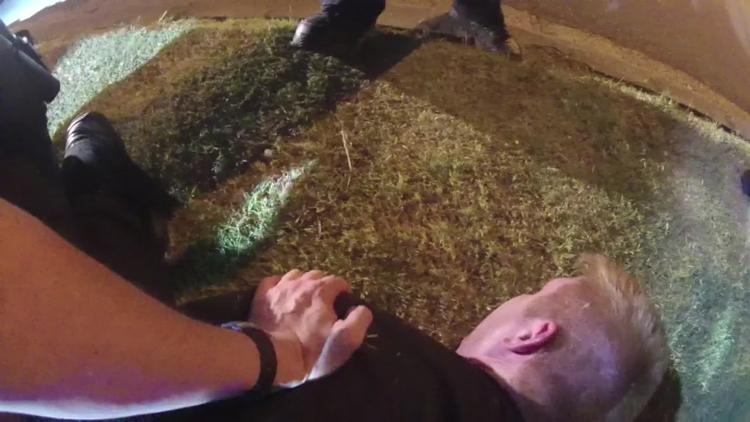
But the body camera footage released this week shows the officers holding Timpa in a prone position, face down in the grass while officers swap out his handcuffs and and zip-tie his legs. Timpa can be seen struggling, begging the officers to stop holding him down. He screams, “You’re gonna kill me.” One of the officers repeatedly tells him to relax, saying “You’re going to be all right.”
The footage shows Timpa, his face down in the grass, falling unconscious. The officers can be heard making jokes about Timpa falling asleep and about waking him up for school. One officer appears to mimic a teenager, saying: “I don’t want to go to school! Five more minutes, Mom!”
The footage shows officers and paramedics putting Timpa’s lifeless body onto a gurney, and one of the officers can be heard asking, “He didn’t just die down there, did he?”
Once in the ambulance, paramedics tell the officers he is not breathing.
A review of the footage by CNN appears to show Timpa stopped breathing within 20 minutes of police arriving. He was later pronounced dead at a local hospital, according to court documents.
Charges dismissed against officers
Three police officers were indicted on charges of misdemeanor deadly conduct, according to the 2017 police press release and court records.
The indictments were handed down more than a year after Timpa’s death and three months after The Dallas Morning News published its investigation into the death.
On March 18, the Dallas County District Attorney’s office dismissed the charges, saying the decision was made following a lengthy investigation into the official cause of death and a discussion with three medical examiners.
“They stated they do not believe the officers acted recklessly. Additionally, they cannot, and will not, testify to the elements of the indictment beyond a reasonable doubt,” according to a news release by the DA’s office.
CNN’s Jason Morris, Brad Parks and Sheena Jones contributed to this report.
Photo Credit: Dallas Police Department via CNN Wire